The story
Frombork1514
Nicolaus Copernicus spent most of his life as a church administrator in Frombork, a small cathedral town on the Baltic coast of what is now Poland. He held a doctorate in canon law, practised medicine, managed estates, wrote on currency reform and, during a war with the Teutonic Knights, organised the defence of a castle. Astronomy was what he did in the tower after the paperwork.
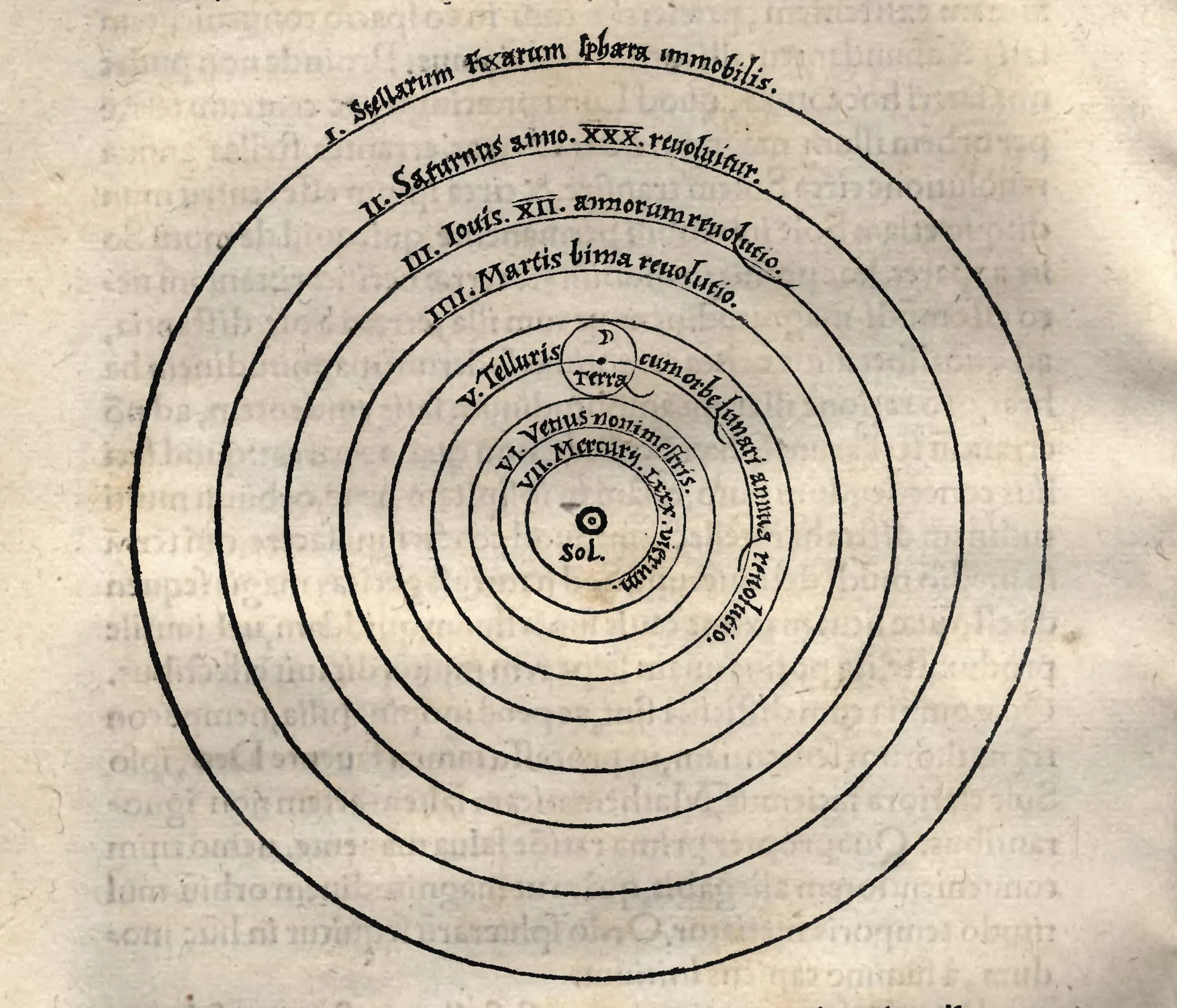
Around 1514 he circulated a short handwritten sketch of a strange idea: the sun sits still, and the earth moves. Then he sat on the full argument for almost thirty years. It took a young Lutheran mathematician, Georg Joachim Rheticus, turning up uninvited in 1539 and refusing to leave, to get the manuscript to a printer. De revolutionibus orbium coelestium appeared in Nuremberg in 1543. According to a friend’s letter, a copy reached Copernicus on the day he died.
The book was dedicated to Pope Paul III. It carried an anonymous preface, slipped in by the theologian who saw it through the press, Andreas Osiander, assuring readers that the whole thing was merely a convenient hypothesis for calculation. It sold modestly, was read closely by the handful of astronomers who mattered, and caused no public scandal. The Church did not touch it until 1616, seventy-three years later, when the Galileo affair made heliocentrism a live question. Even then it was only “suspended until corrected”.
These hypotheses need not be true nor even probable. If they provide a calculus consistent with the observations, that alone is enough.
The gap
Two things about the word are backwards.
First, the model was not better. Copernicus kept the perfect circles and the epicycles that came with them, and his tables were no more accurate than Ptolemy’s. The revolution he is credited with was finished by other people: Kepler’s ellipses, Galileo’s telescope, Newton’s gravity. What Copernicus did was move the centre, and then die.
Second, the “revolution” in his title meant the opposite of what we mean by it. Revolutio was an orbit: a thing going round and coming back to where it started. The political sense, a violent break with the past, grew up later, and Hannah Arendt argued it grew partly out of this astronomical word. A book about eternal recurrence lent its title to the idea of a clean break.
And the phrase “Copernican revolution” is usually credited to Immanuel Kant, who is said to have used it for his own philosophy. He never wrote it. In the 1787 preface to the Critique of Pure Reason he speaks of “the first thought of Copernicus”. The label was pinned on him by later readers, which is how these things go.