The story
Nottingham1811
On 11 March 1811 a crowd of framework knitters in Arnold, outside Nottingham, broke sixty-three of the frames they worked on. They were skilled men whose trade was being undercut two ways: wages were being cut, and some masters were using wide frames to make cheap, shoddy stockings, cut-ups, that were passed off as the real thing. The attacks went on for months, at night, in small groups, and the letters that came before and after them were signed Ned Ludd, or General Ludd, of Sherwood Forest.
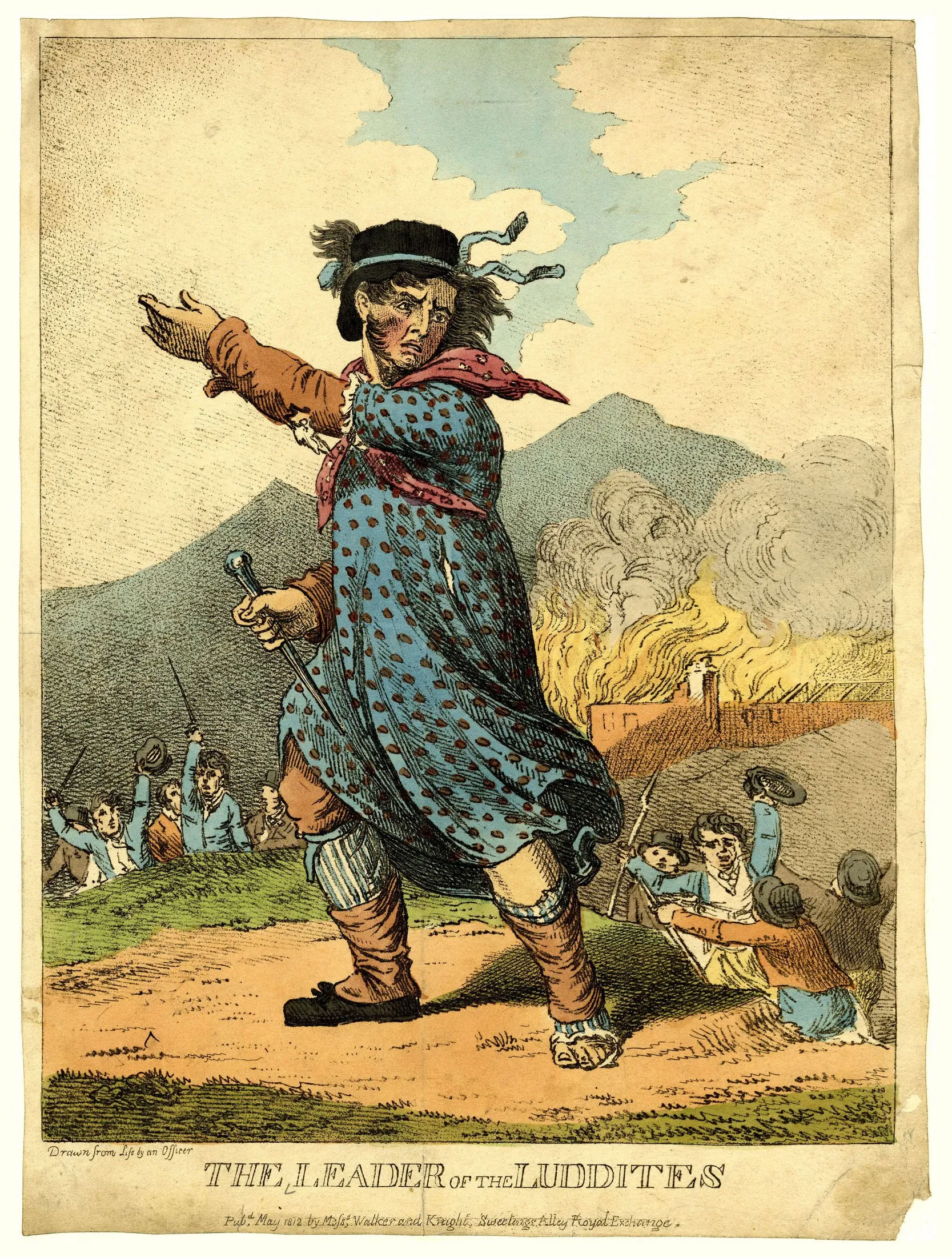
Ned Ludd is the reason for the name and there is no evidence he was a person. The story, that a Leicester apprentice called Ludd smashed two frames in a rage in 1779 after a beating, first appears in the Nottingham Review in December 1811, thirty-two years after the event and nine months after the movement that needed him. He was a signature that could not be arrested.
The government sent more soldiers into the Midlands and the north than Wellington had in Portugal, and in February 1812 made frame-breaking a capital crime. Byron, twenty-four, used his first speech in the House of Lords to ask whether there was not blood enough on the penal code already. Seventeen men were hanged at York the next January. By 1816 it was over.
The gap
The Luddites broke the frames of masters who cut wages or made cut-ups, and left the others alone. Their quarrel was with what the machines were being used to do to them, not with machinery. Most of them had spent their lives at a frame. The word now means someone who is afraid of a new phone, which is close to the opposite.
The man is a newspaper story and the movement is remembered backwards. That is a lot of drift for two hundred years, and it is picking up speed.